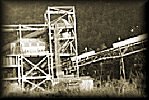
1914 No. 5 Eccles Mine Explosion
The second worst mining disaster in West Virginia occurred 28 April
1914 when the No. 5 mine at Eccles, WV exploded. A cemetery monument
placed in honor of the men who died lists 183 names. However,
Pauline Haga in her book, Raleigh County WV Death Records Vol.
3 1896-1914, gives the count as 186 deaths due to the explosion.
The mine was opened in 1905. It was owned by the Guggenheim
family of New York City and managed by the New River Collieries
Company until the Stoneage Coke and Coal Co. took over operations
in 1923. Stoneage operated the mine from 1923 until 1928.
Eccles was a gaseous mine, as noted in the "1911 Annual Report of
the Department of Mines" released by the WV Department of Mines.
However, the ventilation required for gassy mines was adequate
and appeared to be up to standards. The Department of Mines
was not expecting a major tragedy at Eccles.
Why did Eccles No. 5 explode? James L. Wood takes an in
depth look at the Eccles Explosion in his book Raleigh
County, West Virginia. In it, Mr. Wood quotes from the
official report filed by the State mine inspectors as
to the cause of the explosion:
"...Judging from the conditions found in the No. 5
mine after the explosion, and the evidence taken at
the inquest, it was conclusive that the explosion
was caused by a barrier of coal being shot out by
some person a short time before the explosion occurred,
as the first right entry off of main east had been
driven to the south off the east entry and to the
north and south off of room No. 10 off of main
south entry.
"About February 1st, the entry driven to the north came
within about 4 feet of the connection with the entry driven
to meet it from the main east. A contractor working on the
south side of the barrier was notified not to shoot down the
last cut, as it would disarrange the ventilation and this
barrier stood intact from that time until the morning of the
explosion, as testified to by the night fire boss who examined
the same the morning of the explosion.
"When the workmen reached that section after the explosion,
they found that a hole about 42x84 inches had been blasted out
of this barrier and that a hole was loaded and tamped and the
fuse wires exposed ready for exploding, near the left rib. The
fire boss stated that this condition did not exist in the early
morning when he made his inspection, but that the coal barrier
was intact, as it had been since February 1st.
"The removing of the barrier short circuited the ventilating
current from the south entry through No. 8 room, which was
connected with the north section of the first right and back
through the first right, through its regular air channel to
the return air shaft, leaving the advanced working of the
first right and the main south headings without ventilation.
"It appears from evidence that Seth Combs, a contractor, had
been negotiating with the mine foreman for additional places
on the far right east on the north side of the barrier, in
addition to what he had on the south side.
"After the explosion the body of Combs was found on the
north side of the barrier...while his work was on the south
side, and it is assumed that sometime during the day he had
blasted out a hole in the barrier that he might have a
shorter travel way to the north section of the entry.
In doing so, practically one-third of the mine was left
without ventilation and it seems that the explosion
originated in the main south sections of the mine, as
it was known to liberate explosive gas and the coal in
this section, varying in thickness from eight to ten feet,
would allow the gas to accumulate next to the roof, as
the conditions showed this explosion was caused by the
ignition of gas and its propagation throughout the various
parts of the mine was aided, to some extent, by the presence
of coal dust, as the force of the explosion travelled in all
directions..."
Many of the victims were never identified because of the degree
of destruction at the mine. Those who were able to be identified
were buried in family cemeteries if they were local men, and
some of the Catholic immigrant miners were taken to St.
Sebastian Cemetery in Beckley. Those who were not able to
be identified were buried in the "Polish Cemetery" above the
tipple. In 1976, the bodies were moved to a new cemetery at
the request of the Westmoreland Coal Company, who was then
mining Eccles coal.
Information compiled by Melissa Bailey Duggins, 18 Jan. 1999,
from the following sources:

1.  Wood, James L., Raleigh County, West Virginia, Sponsored by
Raleigh Co. Historical Society 1994, Printed by BJW Printing and
Office Supplies, Beckley, WV 25801, pages 351-360.

2.  Haga, Pauline, Raleigh County WV Death Records Vol. 3
1896-1914, Published by author, Box 1061, Crab Orchard, WV 25827,
n.p.

3.  Haga, Pauline, A Tribute To The Coal Miner Vol. 1, Published
by author, Box 1061, Crab Orchard, WV 25827, pages 3 and 8.

Any of the above named books would be recommended reading if you
would like more detailed information about the 1914 Eccles
Explosion.  Another book, They Died In The Darkness, by Lacy
A. Dillon gives additional information about this and other WV
coal mine disasters.